
From the Drophaus to the deep end, everything that happened at, around, and after Pharrell's most ambitious LV show yet
Cover Image Credits: Victor VIRGILE/Gamma-Rapho via Getty Images
Audacious set design has become the defining grammar of Pharrell’s tenure. He has staged collections inside a giant wooden freight crate at Fondation Louis Vuitton. He has built a supersized Snakes and Ladders board at the Centre Pompidou for SS26, a collaboration with Studio Mumbai’s Bijoy Jain that eventually became the subject of its own documentary. Each season, the set is not a backdrop, it is a thesis statement.
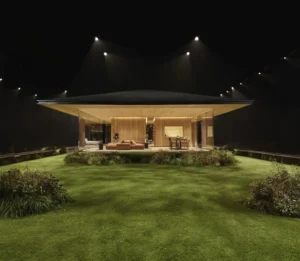
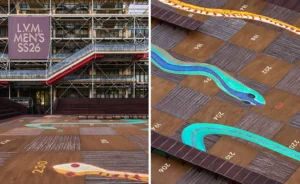
Image Credits: wallpaper*
For the SS27 show, staged on the grounds of Cité Internationale Universitaire de Paris, the thesis was water. On the evening of June 23, 2026, Pharrell transformed the venue into a manufactured shoreline: an ocean sourced from Eau de Paris, the corporation that manages the city’s aquatic network, a moon rising on cue, and somewhere in the middle of it all, a glass-walled camper van parked on imported sand. In a city far removed from any coastline, he effectively conjured a beach from scratch.
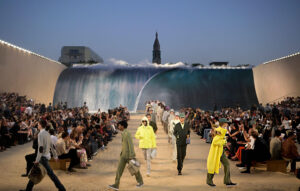
Image Credits: Kristy Sparow/Getty Images
Referencing this kind of show design calls up the old vocabulary: Marc Jacobs’ steam train in the Louvre, Karl Lagerfeld’s rocket ship. What Pharrell’s sets share with those spectacles is a refusal to treat fashion week as merely a clothes-delivery mechanism.
The entrance to the venue was marked by a Louis Vuitton-branded air bus, the first visual cue in a collection routed through surf culture, nomadic freedom, and the particular mythology of someone who surfs not for sport but for life.
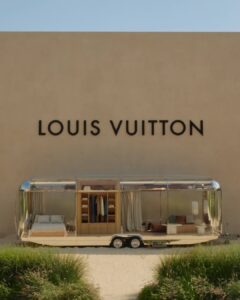
Image Credits: Louis Vuitton
There was also controversy. Before the show, students, researchers, and local residents had been protesting the privatisation of the campus lawn. A petition gathered more than 1,300 signatures. The administration’s response cited eight million euros in public funding cuts that made private event revenue necessary. It is the kind of friction that follows any institution wealthy enough to reshape a neighbourhood, and it sat unresolved in the background as guests took their seats.
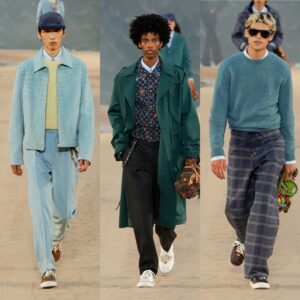
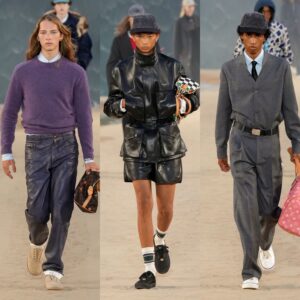
Image Credits: OUTLANDER MAG
The clothes married Pharrell’s streetwear instincts to the laidback visual language of surf culture without collapsing into costume. But this season, the accessories remained the category where Pharrell is most confidently inventive. The new LV Combi sneaker debuted here, more on that shortly.
In a celebration of surf culture’s visual language and lifestyle, before a single look appeared on the runway, the show opened with a cinematic prelude, and that film deserves its own paragraph. Co-starring professional surfers Mikey February and Julian Wilson, it was directed by February himself, marking his directorial debut. February, a South African surfer, founded Ebony Beach Club as an ongoing effort to make surf culture more accessible to Black communities, a project rooted in the reality that the global image of surfing has long defaulted to one demographic.
View this post on Instagram
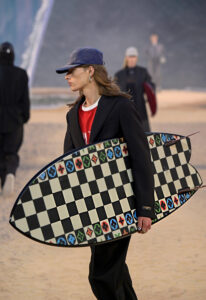
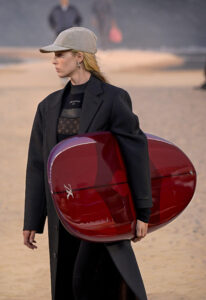
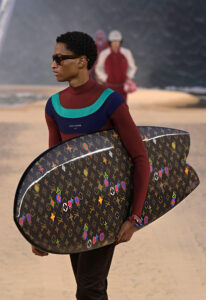
Image Credits: Kristy Sparow/Getty Images
Surfboards branded with the Monogram were among the collection’s most notable objects, alongside Louis Vuitton’s signature trunks and luggage pieces. They were not decorative touches. The closing looks brought the surfboards back, full-sized, as the wave held behind the models on the runway.
The soundtrack, as always, was Pharrell’s production, recorded at Louis Vuitton’s in-house recording studio. An 80-piece classical orchestra and gospel choir performed live, continuing a now-familiar tradition. The score also featured new music from NBA Youngboy, Lil Baby, Quavo, and Angélique Kidjo.
Pharrell has consistently deepened Louis Vuitton’s ties to African artists, so it was no surprise to see figures such as Wizkid, Asake, Skepta, and stylist Walter Banks among those present. Across his tenure, he has repeatedly woven African creatives into Louis Vuitton’s cultural orbit, making them recurring fixtures within the house’s expanding cultural programme.
On the same day Paris Fashion Week Men’s SS27 opened, June 23, 2026, a separate Pharrell story was already circulating: the Louis Vuitton Combi.
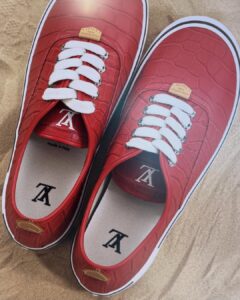
Image Credits: skateboard
The Combi is a new sneaker Pharrell previewed for SS27. The silhouette looked, to a significant number of observers, very much like a Vans Authentic.
Vans responded directly on social media. Their comment on Pharrell’s initial post read: “Ohhhh bet.” The brand followed up by sharing a promotional image of the red Vans Authentics with the caption: “Wanna know the time? Better clock us.” The caption is lifted from Clipse’s 2006 track “Mr. Me Too”, a Pharrell production, a Pharrell song, used by Vans to point back at the man himself.
Tyler, the Creator, longtime Pharrell collaborator, Golf le Fleur founder, and frequent Converse partner, weighed in: “Y’ALL KNOW THIS STYLE OF DECK SHOE FOR BOATS HAS BEEN AROUND BEFORE VANS CORRECT? PRO KEDS, CONVERSE, ETC.”
The deck shoe’s history is, technically, correct. The plimsoll silhouette predates Vans by decades. But design discourse rarely runs on technicalities, and online sentiment was not in a particularly generous mood. Critics drew parallels to Pharrell’s Humanrace Samba variations for Adidas, which faced similar accusations of being more material swap than genuine design invention.
There is a version of this story where the deck shoe’s age is dispositive. There is another where the question is what Louis Vuitton, at this price point and with this creative director, is doing with a silhouette this familiar.
What’s worth watching is that the Combi will drop regardless, in multiple Monogram colourways, and will probably sell well. The controversy is the kind that generates its own attention. Whether that attention serves the shoe or the broader argument about Pharrell’s design range remains to be seen.
Three years into his tenure, Pharrell Williams has done something at Louis Vuitton that is harder than it sounds: he has made the job look inevitable. Each show has been a world-building exercise rather than a seasonal delivery. He has brought India, through the SS26 Studio Mumbai collaboration, futurism and craft through FW26’s Drophaus, and now the global surf community through SS27’s tidal wave, into conversation with a 130-year-old house.
The LV Monogram, which turned 130 this year, appeared in stained glass, wetsuit prints, surfboards, and bicycles, absorbing it into worlds rather than simply stamped onto objects.
The shows also come with environmental partnerships now; SS27 is linked to Coral Gardeners, with plans to out-plant 1,000 corals in French Polynesia’s Tiaia restoration site and restore 250 square metres of reef habitat as part of LV’s Regeneration 2030 sustainability roadmap. The show’s wave, powered by city water and returned to the sewer system post-show, operated as a closed loop. These moves do not neutralise the carbon cost of a Paris Fashion Week spectacle, but they point toward an intention to make the storytelling legible beyond the fashion calendar.
What Pharrell is building at Louis Vuitton is not avant-garde. Critics who come looking for structural experimentation often leave disappointed. What he is building is something closer to cultural inevitability, a version of menswear so embedded in the visual grammar of global desirability that it does not need to innovate in the traditional sense. As Louis Vuitton remains the largest luxury fashion house in the world, he may not need to reinvent the wheel in the conventional sense.