
I could start this review by telling you how brilliant Ayra Starr’s Starrgirl rollout has been, from the fan-made Starrgirl Snapchat filter to the purple gele, but I know you’ve already seen all that. Or maybe I could tell you how this album was needed to remind everyone why she belongs in the conversation, if anyone had somehow forgotten who she was. That’s nice too, but when you hear an intro like Dangerous, you need to go right into it. Headfirst.
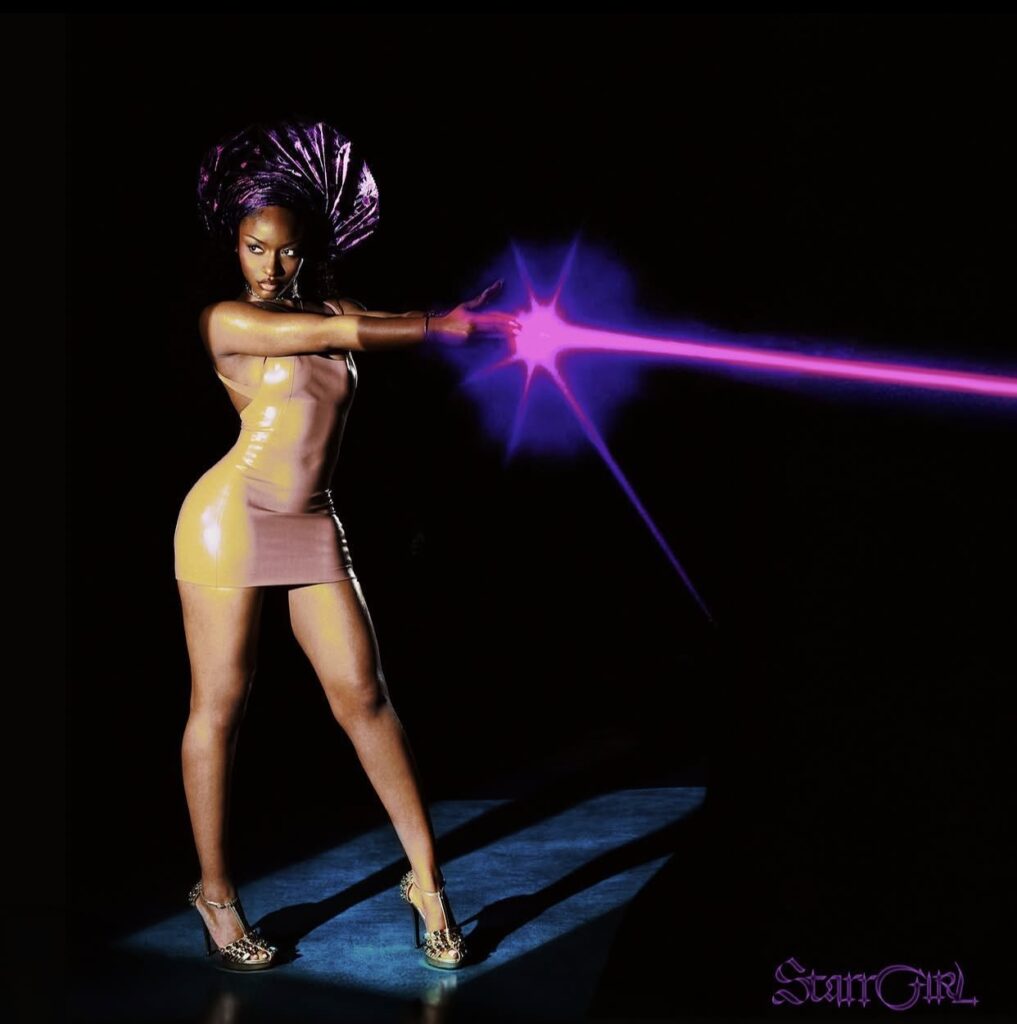
In an era where a lot of artists go introspective, Ayra goes full braggadocious on her intro, and it is fitting that she does. Anything other than an opening declaration of “I’m that babe” would have been a travesty. The album is called Starrgirl. She had to tell you from the jump.
What captivates first is Terry Apala, opening things up the way only he can, introducing himself and letting you know Ayra is here. Then the beat kicks in, a reworking of Wande Coal’s Kiss Your Hand featuring Ikechukwu, originally produced by Don Jazzy and now reworked by Ragee. That’s what gets things rolling. Ayra goes off: “Starr girl I don’t play around, when the money that be coming is the right amount. What they do now, we already done that.” She and Terry Apala combine for the chorus, and it is vocal bliss. This is the statement intro. Stop whatever you’re doing, sit down, and let’s go for a ride.
Strapped in for that ride, she goes full R&B and sensual on Amazing with British singer kwn. It is a song about the chemistry between two people who want each other, with Ayra setting the tone through an intimate verse, pre-chorus and chorus before kwn takes over and expands on the theme in the second verse. They trade the final chorus between them, their different vocal textures blending beautifully. Amazing also takes a leaf out of Rihanna’s Kiss It Better; the strings give it a similar feel, making the whole thing soothing and faintly nostalgic.
Seamless transitions are one thing I always look out for on an album because stop-starts can wreck the flow, and Ayra pulls off plenty of them here. From Amazing straight into Gimme Dat featuring Wizkid is one of the smoothest. It is a familiar song by now, a Grammy-nominated highlight that still sounds as fresh here as it did on release.
Pressure with Leon Thomas keeps circling that same attraction and chemistry, but with more upbeat energy behind it. “Apply that pressure, pressure, pressure,” the chorus goes, and once again we get a trade-off between two artists who can sing.
Then comes Tornado, another familiar face, all confidence and feminine allure, with Ayra fully in command of her body and her star power. FOLA’s vocals remain a lovely, much-needed surprise. Ayra has said the song came together on instinct rather than anything overthought, which tracks; it has the loose, sure-footed energy of someone not second-guessing herself.
The willingness to experiment is part of what makes Ayra special, and she leans into her Afro-house side on Midnight in New York. She is singing about a lived experience in the city she moved to almost a year ago, painting the night in detail: “Bare back dress, heels in my hands. I said leave your phone, leave your plans, follow me with your hands. Midnight in New York, we don’t talk, we dance. Midnight in New York, we get lost in these feels.”
There is something worth knowing underneath the confidence too. By her own account, the move to New York was daunting, with her first apartment left furniture-less for months before she found her footing. None of that anxiety makes it onto the track, and that is sort of the point. It is a perfect night set over Afro-house beats that keep you bouncing. Sensual, but never static.
Hot Body needs little introduction either at this point, another pre-release single that slots into the album without feeling out of place. It is a sensual celebration of physical attraction, with Ayra flaunting her body, confidence and the effect she has on people.
But there is more intention behind it than the song’s cheeky surface might suggest. Speaking about Hot Body on Apple Music’s The Dotty Show, Ayra said she had reached a point where she wanted her music to reflect her own experiences again, particularly as she was “becoming a woman” and “owning businesses”. “Look what a hot body can do,” she said, framing the song as an expression of where she was in her life at the time.
That makes the song feel less like a throwaway confidence anthem and more like a snapshot of Ayra becoming increasingly comfortable in her own skin.
Ms. Paper, featuring Congolese-French artist Théodora, keeps the energy climbing. It is the track that’ll get everyone bopping, the kind that makes you boogie down wherever you happen to be. Ayra explores new ground with Bouyon, the fast-paced genre that originated in Dominica in the late 1980s, and more than holds her own. “Mr Money come see Miss Paper.” Shoutout to Asake, but Ayra is telling you she is the one with the paper here. She and Théodora trade turns over the high-energy production, with Théodora adding French to the mix, and the chorus lands heavily enough to get you moving.
The move into Dance is another clean example of the album’s sequencing. Here, Ayra is on the front foot, grateful for how far she’s come and making that money: “Money constant bi Maphorisa, presidential, I be the chop life minister.” She just wants to dance, free and living her best life, and the track embodies exactly that kind of freedom. She closes it out in Yoruba: “Ago faaji la wa, ago ijo ti ya, bo si gbangba ore, ago ijo ti ya.” Enjoy your life, really. Dance.
From there, Where Do We Go tells the all-too-familiar story of an undefined relationship, a situationship, as it is fondly called. The lyrics trace an exhausting loop: Ayra sees exactly what is happening to her and follows it blindly anyway. The final question, “where do we go?” lands hard precisely because both people already know the answer, and neither will say it out loud.
Who’s Dat Girl is a collaboration that had been needed for a long time, and even with it having been out for a while now, Rema’s verse still stands out as one of the best on the album. His flow and control are impeccable. That chemistry is not manufactured either; the two have known each other since before Ayra’s debut, and she has spoken about how being in the studio with him raises the standard for everyone in the room. Ayra levels up to him in her second verse, and together they make something that still commands attention. The interpolation of Eve’s Who’s That Girl lands perfectly.
Misunderstood charts a different course entirely, one about identity and standing apart from everyone else:
“She was a black sheep in the middle of a white room. She was a lone wolf in a pack full of plus twos. They told her, ‘Never could, never would, never should, never make it on her own.’ They were wrong, they were wrong.”
It is an empowerment song, a quiet anthem for the girl who was written off and kept going anyway. The writing holds two seemingly opposing truths together with real elegance: she is both unbothered and heartbroken, the outsider and the one who ends up winning. She does not need to explain herself. She just needs to keep moving.
It is not just a performance either. Ayra has talked openly about the doubt behind the confidence, admitting, “I have stages of doubt, but then my stubbornness kicks in.” Misunderstood is that sentiment turned into a record.
The vulnerability does not stop there; it just changes shape. Misunderstood pushes back against the world, while Letter to God and Heaven Baby lean fully into love, becoming the album’s softest stretch.
Letter to God is my favourite song on the album. Ayra starts singing from the first second with a voice and melody that captivate instantly. The song centres on love, faith and protecting a relationship from external doubt, using a letter to God as a stand-in for the reassurance she can’t quite say directly, hoping their connection proves destined despite the rumours and interference, and that it will ultimately be blessed.
The outro carries you out gently, with the keyboard arriving first, before her vocals and percussion join in to properly round off what is, without exaggeration, a masterpiece.
Yearning reaches its peak on Heaven Baby featuring Zayn Malik, a song about romantic longing and devotion unlike anything else on the album. Both artists express an intense desire for someone they see as almost heavenly. “You could be my heaven, baby,” Ayra sings, while beneath that longing sits the fear of losing the person who has become so important to her. “You tell me jump, I’ll jump, just say how high,” Zayn answers on his verse before they meet again on the chorus.
At its core, Heaven Baby is about what it feels like to fall deeply in love, to see someone as a source of peace and purpose, something greater than ordinary life. And that in itself is a wild thing to experience.

Treasure pulls the album out of that reflective stretch and closes things as a victory lap. She opens plainly: “I do this for myself, and the people wey dey carry me for chest.” She is grateful for the love, knows exactly where she is heading, and sounds fully assured that she is getting everything she deserves. Her Yoruba outro echoes Dance, bringing that sense of freedom back into the album’s closing moments.
The Hot Body remix with Venezuelan singer and songwriter Danny Ocean plays as exactly that: an extra tacked onto what is otherwise a complete album. Treasure is built as a closing statement, and the outro gives it a finality that feels genuinely earned. The remix arriving after that natural conclusion reads more as a commercial reach towards Latin pop audiences than a real artistic decision.
Ayra Starr has come of age. From 19 & Dangerous through The Year I Turned 21 to Starrgirl, that growth is evident in her writing, her delivery, her genre flexibility and, perhaps most importantly, her confidence.

At a time when Nigerian music is increasingly exploring new directions, Starrgirl is a reminder that experimentation does not have to come at the expense of an artist’s essence.
On Starrgirl, Ayra experiments, but at exactly the right level, helped by how effortlessly she moves across multiple genres. She has described the album as an exercise in allowing herself to exist in “multitudes”, drawing from the different places she has lived and the sounds she has absorbed along the way.
Starrgirl is a great album: varied, confident and remarkably light on filler. Ayra tells you she’s “that babe” on the intro, then spends the rest of the album showing you what that means. There is the swagger of Dangerous, the sensuality of Hot Body, the vulnerability of Letter to God, the yearning of Heaven Baby and the resilience of Misunderstood. They are different sides of the same artist, and none cancels the other out.
That might be the album’s biggest takeaway. Starrgirl brings all these sides of Ayra Starr into the same world, without making any of them feel out of place. The result is an album that feels expansive, but never scattered.